
Humat 4-Way Hydrant Valve
Five Decades of Delivering Water to the Fire Scene With the Humat 4-Way Hydrant Valve
The Humat 4-Way Hydrant Valve was born from a real fireground challenge that two retired firefighters — three fire service veterans in all — set out to conquer, and that same commitment to the Humat 4-Way Hydrant Valve continues today under new ownership.
Explore the complete specifications, dimensions, and coupling options behind the Humat 4-Way Hydrant Valve — the hydrant boost valve fire departments have trusted for fifty years — and reach out anytime you’d like a formal quote or bid specification wording for your next Humat 4-Way Hydrant Valve purchase.
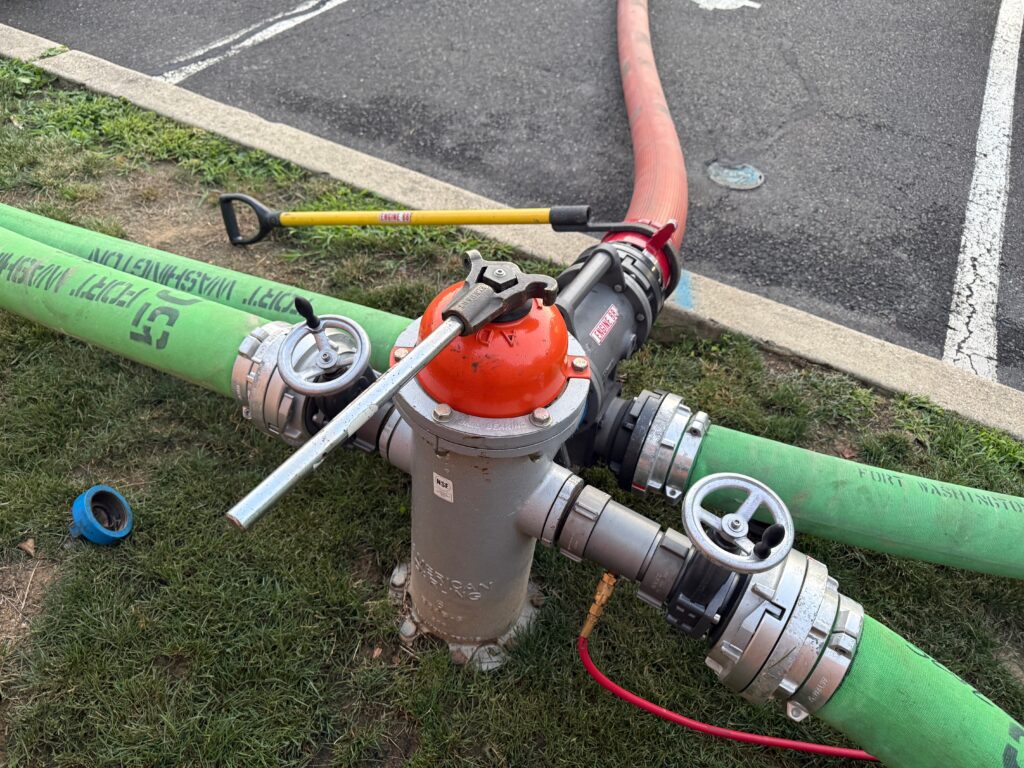
Humat 4-Way Hydrant Valve Configuration and Specification Support for Fire Departments
Fire departments rarely arrive with a part number in hand. They arrive with a fleet, a hydrant network, and hose and thread standards accumulated over years — frequently spanning several generations of apparatus. That is exactly where configuring the Humat 4-Way Hydrant Valve begins. Share your current hose diameter, your thread or coupling standard, and roughly how much flow you anticipate needing, and we’ll determine how to set up the Humat 4-Way Hydrant Valve for your operation.
For engine-side hydrant work — where a first-due engine places the valve at the hydrant and needs automatic switchover from hydrant pressure to pump pressure — the Humat 4-Way Hydrant Valve is engineered precisely for that task, handing off seamlessly so crews never lose water. If you’re unsure how to spec the Humat 4-Way Hydrant Valve for your operation, answering exactly that question is why this service exists. Nothing needs to be finalized before you reach out, and we’re glad to walk through the tradeoffs before you commit.
Quotes and Bid Specification Wording for Municipal and Industrial Purchasing
Municipal fire departments and large industrial facilities rarely buy equipment straight off the shelf. Orders move through budget cycles, formal bids, and procurement reviews, and every stage demands documentation that holds up under scrutiny. When you request a quote for the Humat 4-Way Hydrant Valve, we build pricing around your configuration, share current lead times so you can plan around a budget year or bid deadline, and provide Humat 4-Way Hydrant Valve bid specification wording tailored to your setup whenever your purchasing process requires it.
Most quote requests receive a reply within one business day — whether you’re pricing a single Humat 4-Way Hydrant Valve for one engine or standardizing an entire fleet or facility, because we handle both ends of that range and everything in between.
Collaborating Directly With Safety, Engineering, and Procurement Teams
Industrial sites, refinery fire brigades, and airport authorities often bring several decision-makers into an equipment purchase. We’re glad to speak directly with your facility’s safety officers, engineering staff, or procurement team while specifying the Humat 4-Way Hydrant Valve, so the configuration on the purchase order matches your site’s standards from the start rather than needing corrections after delivery.
Coupling and Flange Configuration for Any Thread Standard
The guiding principle behind every Humat 4-Way Hydrant Valve is that the valve body should never become obsolete simply because your hose changed. Couplings and flanges bolt on separately from the body and seal with O-rings, letting us configure the Humat 4-Way Hydrant Valve for nearly any standard thread size or Storz-type quick connect. Flange choices include NHT, Storz, pipe, local thread, and weldable flanges — all interchangeable across the Humat product line.
Because each port accepts its own flange, a single Humat 4-Way Hydrant Valve can even be built with mixed couplings — NHT on one side and Storz on the other, for example. That flexibility helps departments transitioning between standards and agencies that routinely connect to gear from neighboring mutual-aid partners.
Retrofitting New Couplings Onto Existing Humat Valves
If your department changes thread type or hose size, there’s no need to buy new appliances. We can supply the flanges and couplings to reconfigure the Humat 4-Way Hydrant Valves you already own. That protects your original investment and keeps a proven Humat 4-Way Hydrant Valve on the apparatus for as long as the apparatus remains in service.
Switching Your Fleet to the Humat 4-Way Hydrant Valve From Another Brand
Replacing an existing 4-way valve shouldn’t force every crew member to relearn hose connections while also adapting to a new appliance. When a department moves to the Humat 4-Way Hydrant Valve from another brand, we ask for the hose diameter and the thread or coupling standard used across the fleet today. Because the couplings on the Humat 4-Way Hydrant Valve bolt on independently of the valve body, we can usually match that existing configuration exactly. Crews keep making the same connections they already know, and the only thing that changes is the valve in the middle.
Bracket and Apparatus Mounting Guidance for Fire Engines
Where and how a valve rides on the apparatus affects both deployment speed and crew safety. For the Humat 4-Way Hydrant Valve, we offer rigid brackets — with or without a strap — plus fold-down brackets designed for tailboard mounting. As part of our mounting service, we’ll help you choose the right one for your rig.
Our general guidance is to avoid mounting a rigid, uncovered bracket on the tailboard itself, since an empty bracket there can snag a firefighter’s foot or pant leg. The fold-down bracket is the safer choice in that spot, while the rigid bracket usually suits a side-mount or compartment location better. Every engine layout and hose setup differs, though, so send us photos or measurements of the location you have in mind and we’ll recommend a Humat 4-Way Hydrant Valve mounting configuration that fits your apparatus.
Humat 4-Way Hydrant Valve Supply for the Humat 4-Way Hydrant Valve
A worn component shouldn’t sideline a valve for weeks. Most standard Humat 4-Way Hydrant Valve parts ship the business day after we receive your order, and if a larger or custom order needs more time, we’ll tell you up front. The items departments order most for the Humat 4-Way Hydrant Valve are O-rings, which seal every flange connection; flange bolts, which can loosen or corrode over years of service; bracket straps, which wear from repeated mounting during apparatus checks and calls; and handle assembly parts, which endure more repeated motion than anything else on the valve.
To speed an order along, have your Humat 4-Way Hydrant Valve model, your current coupling or thread configuration, a part or serial number if available, and the quantity you need. Exploded-view parts diagrams exist for both standard-threaded and Storz connections, so your team can identify components from the diagram instead of guessing. Many departments and fire brigades also keep a small stock of O-rings and flange bolts on hand so routine maintenance never waits on a shipment, and we’re glad to help you assemble that kind of starter kit.
Request a Quote, Order Parts, or Ask a Technical Question
Whether you need a configuration recommendation, a formal quote with bid wording, a mounting suggestion, or a single replacement O-ring for your Humat 4-Way Hydrant Valve, the process starts the same way. Call Humat at (501) 628-6332, email humat@humat.com, or use the contact form with your hose diameter, thread or coupling standard, Humat 4-Way Hydrant Valve model if you have one, and what you’re trying to accomplish. We’ll respond with the configuration, pricing, parts, or answers your department needs to keep water moving.